Does hyphosphere microbiome recruitment drive arbuscular mycorrhizal fungal symbiotic strategy?
The first chapter of my dissertation explores how variation in hyphal exudation and recruitment of bacterial associates by arbuscular mycorrhizal (AM) fungi modulates symbiotic phenotypes along the mutualism-parasitism continuum.
In a given ecological context, AM fungal strains differ in phosphorus (P) delivery efficiency relative to host carbon cost. However, the mechanisms underlying this variability in fungal cooperativeness between strains remain unresolved. It is increasingly clear that mycorrhizal phenotypes are not strictly bipartite and outsource key functions like organic P solubilization to third-party bacterial associates. Because AM fungi have a limited capacity to mineralize organic P, their ability to recruit functional microbiomes may represent an important axis of symbiotic strategy. This project tests the hypothesis that cooperative fungal strains will more effectively recruit microbial consortia that enhance P availability than exploitative strains. By linking fungal economic strategy to microbiome recruitment, this work will extend our understanding of mycorrhizal functioning to incorporate bacterial associates with broader implications for the eco-evolutionary stability of this ubiquitous symbiosis.
Multilevel selection theory as a framework for interpreting context-dependency in mycorrhizal symbioses
My dissertation is largely guided by multilevel selection theory (MLST), an evolutionary framework which posits that selection operates on multiple nested biological scales simultaneously—from genes and nuclei to organisms and multiscale partnerships. In my recent perspective (Katula et al., 2025), I argue that this framework helps explain why arbuscular mycorrhizal (AM) fungi can shift along a continuum from mutualism to parasitism depending on ecological context.
Rather than treating mycorrhizal phenotypes as intrinsic properties of a fungal strain, MLST highlights how outcomes emerge from interactions among competing and cooperating entities at different levels. Selection may favor selfish traits at one level (e.g., rapid fungal growth within roots) while favoring cooperative traits at another (e.g., nutrient exchange that enhances plant fitness). Ecological conditions such as nutrient exchange, spatial structure, and stress, modulate which level of selection dominates.
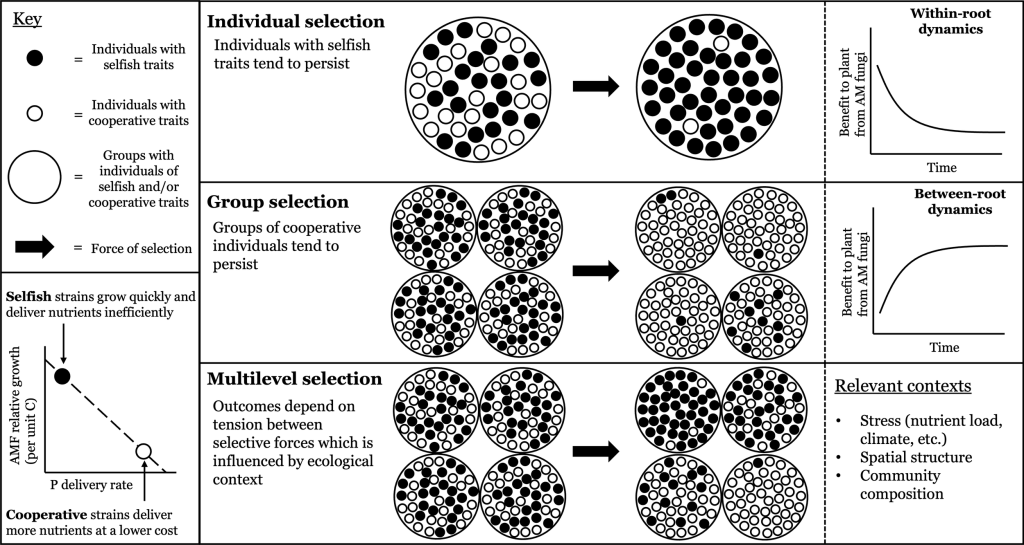
Figure from Katula et al. 2025
Across my dissertation chapters, I apply this multilevel lens to understand how microbial interactions, symbiotic function, and community assembly are shaped by context-dependent evolutionary forces.
Katula, A.M., N.C. Johnson, V.B. Chaudhary & M.E. Afkhami. Multilevel selection theory informs context-dependent mycorrhizal functioning. Front. Microbiomes. 4:1676639. doi: 10.3389/frmbi.2025.1676639.
 Anne M. Katula